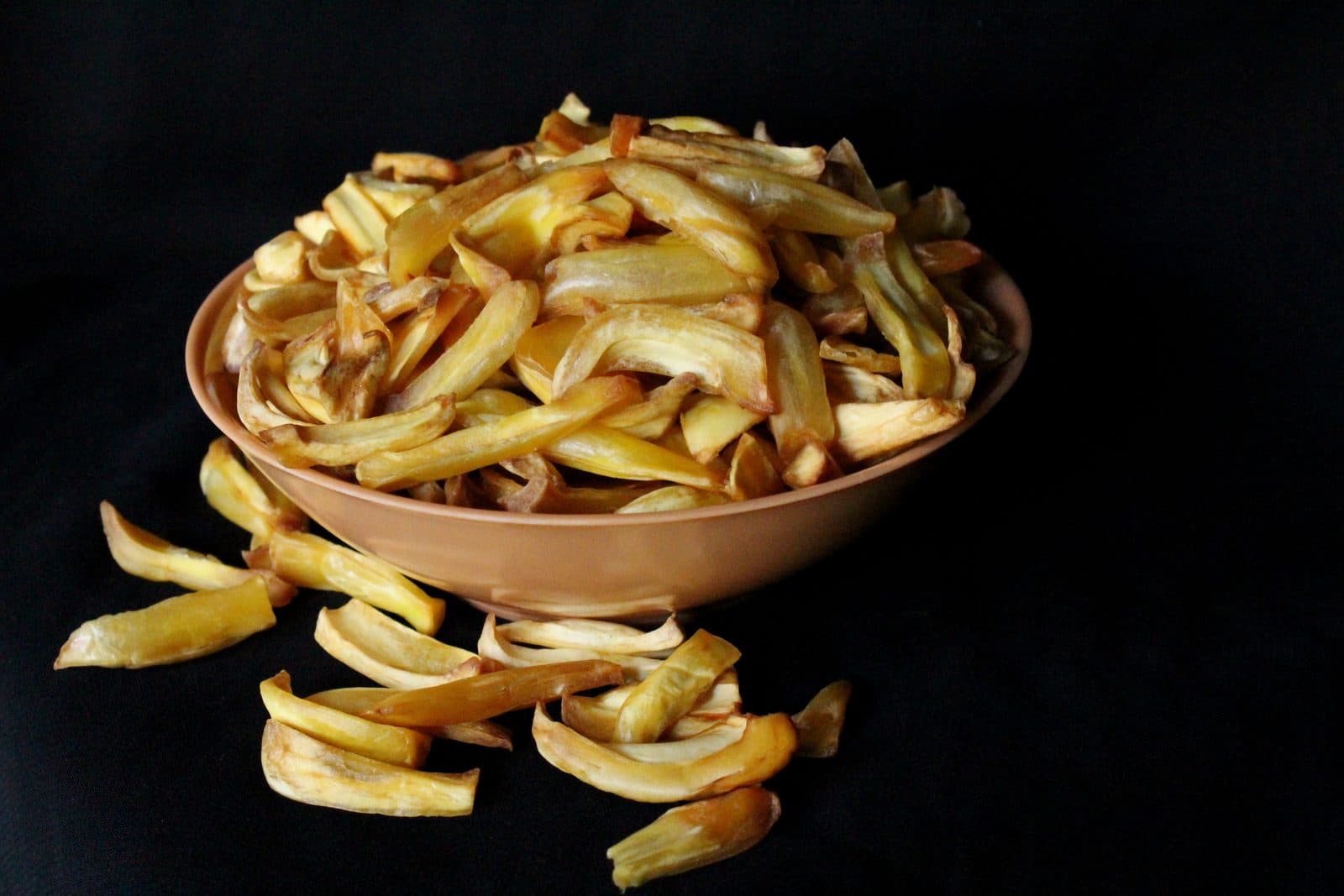
Short answer: a vacuum fryer fries food in a sealed chamber with most of the air pumped out. At that low pressure water boils off at a much lower temperature, so chips dry and turn crisp in oil at about 80 to 120 °C, where an ordinary fryer needs 150 to 180 °C. It is used mainly for fruit and vegetable chips such as banana, jackfruit, apple, mango and carrot.
Vacuum frying is done "under pressures well below atmospheric levels (below 6.65 kPa)", in the words of Rosana Moreira's 2014 review; a 2020 study puts it at "below 10 kPa", where water boils at 44.3 °C. This guide explains how the machine works, compares it with ordinary and air fryers, lists the types and the prices makers publish, and names the makers whose own sites show a vacuum fryer.
We don't sell machines. Tell us what you want to fry and how much, and we'll put you in touch with makers who fit.
Vacuum fryer: key facts
| Question | Answer, with its source |
|---|---|
| What it is | A fryer whose frying chamber is sealed and pumped down below atmospheric pressure: "below 6.65 kPa" (Moreira, 2014) or "below 10 kPa" (Ayustaningwarno et al., 2020) |
| Why it works | Lower pressure lowers the boiling point of water. At 10 kPa water boils at 44.3 °C (Ayustaningwarno et al., 2020) |
| Oil temperature | 80 to 100 °C for jackfruit (Maity et al., 2014) and 118 to 140 °C for potato (Granda et al., 2004) in published studies; makers list 70 to 130 °C (Foodstec) and 80 to 120 °C (VER Food Solutions, Taizy, Zhucheng Xinxudong) |
| Atmospheric frying, for comparison | 150 to 180 °C (Granda et al., 2004) |
| Vacuum level | 100 mbar, optional 35 mbar (tna vac-pro 3); "10% or less of normal atmospheric pressure" (Heat and Control UVF); 300 to 1,000 Pa (Jinan Tindo VF250); −0.1 MPa ultimate (Taizy VF-1200) |
| Heating | Electric, steam or gas, as makers list it (VER Food Solutions, Normit, Jinan Tindo, Taizy) |
| Machine size | Batch machines from "5-6 Kg/Time" (VER Food Solutions VVFM-320) to 200 to 240 kg raw (Taizy VF-1200); continuous lines up to 1,100 kg an hour (tna vac-pro 3) |
| Main uses | Fruit and vegetable chips: apples, bananas, carrots, potatoes and others (Wang et al., 2021); jackfruit (Maity et al., 2014); mango (Ayustaningwarno et al., 2020) |
| Makers | See the list below |
Every figure is from the paper or maker page named in the row, read on 22 Oct 2026.
How does a vacuum fryer work?
A batch vacuum fryer runs one basket at a time. The cycle:
- Load. Sliced and pre-treated product goes into a basket inside the frying chamber.
- Seal. The lid or door closes and locks.
- Pull the vacuum. A vacuum pump takes the pressure down: tna lists 100 mbar (35 mbar as an option) for its continuous fryer.
- Fry. The basket goes down into the oil, or the oil is pumped in. Water leaves the food as steam at a low temperature, and a condenser turns that steam back into water before it reaches the pump.
- Lift. The basket comes up out of the oil.
- Spin. A centrifuge spins the basket to throw off surface oil.
- Release and unload. Air is let back in, the chamber opens and the chips come out to be seasoned, cooled and packed.
The main parts are the frying chamber, the vacuum pump, the condenser, the oil heating (electric, steam, LPG or gas, often through a heat exchanger with a separate oil storage tank), an oil filter, the de-oiling centrifuge and the PLC that runs the sequence. A 2021 review in Foods sums the system up as "a vacuum frying chamber, vapor cooling condenser, and high-intensity vacuum pump". A continuous vacuum fryer does the same job on a conveyor, with airlocks to get the product in and out without losing the vacuum (tna lists a "rotary infeed system and vacuum discharge lock").
Why the spin matters, and when it happens
Moreira's review says plainly that "a de-oiling mechanism is necessary to remove the excessive oil absorption at the surface of the product", and it looks at how pressurisation and de-oiling change the oil left in the chips. Machines differ on when they spin:
- Under vacuum, inside the chamber. Normit says its fryer removes the oil "while the vacuum is held"; Heat and Control and tna build a de-oiling centrifuge or "vacuum defatting unit" into their continuous fryers. In Maity et al.'s jackfruit study the chips "were centrifuged under vacuum at 500 rpm for 8 minutes".
- After the vacuum is released. Some lines spin in a separate machine at normal pressure; the 2020 mango study used an "atmospheric spinner" after pressurising.
Ask the maker which design you are buying, and ask for the oil content of your own product, measured, with each method.
Vacuum fryer vs atmospheric fryer vs air fryer
| Point | Vacuum fryer | Atmospheric fryer | Air fryer |
|---|---|---|---|
| What cooks the food | Hot oil in a sealed chamber under vacuum | Hot oil at normal air pressure | Hot moving air |
| Pressure | Below 6.65 kPa (Moreira, 2014) or below 10 kPa (Ayustaningwarno et al., 2020) | Normal atmospheric pressure | Normal atmospheric pressure |
| Oil temperature | About 80 to 140 °C in the studies cited here; makers list 80 to 120 °C | 150 to 180 °C (Granda et al., 2004) | — |
| Oil in the product | Nearly 50% less (dry basis) than atmospheric in carrot crisps (Dueik et al., 2010); 28.7 to 35.2% in jackfruit chips after 30 min (Maity et al., 2014) | — | — |
| Acrylamide in potato chips | 94% lower than atmospheric at the same final moisture (Granda and Moreira, 2005) | Higher (reference) | — |
| Colour and nutrients | About 90% of α-carotene and 86% of β-carotene kept in carrot crisps (Dueik et al., 2010) | — | — |
| Frying time and cost | "Longer frying time"; equipment "expensive" (Wang et al., 2021) | — | — |
| Scale | Lab, batch and continuous lines (makers below) | Lab to large continuous lines | Mostly kitchen appliances |
“—” means none of the sources we read gives a figure. Results depend on the product, temperature, time and de-oiling; they are study results, not machine guarantees.
An atmospheric fryer is the ordinary industrial fryer used for most potato chips and french fries; see our page on industrial fryers. An air fryer cooks with hot moving air and is mostly a kitchen appliance; it does not use a vacuum.
What vacuum frying makes (vacuum cooking chips)
A 2021 review in Foods says vacuum frying is "mainly used in fruits (e.g., apples, bananas, strawberries), vegetables (e.g., carrots, tomatoes, potatoes, onions), and dried fruits and nuts (e.g., dates, peanuts)". Other products in the sources we read:
- Jackfruit chips: studied by Maity et al. (2014).
- Mango chips: Ayustaningwarno et al. (2020).
- Carrot chips: Dueik et al. (2010), Fan et al. (2006).
- Potato, apple and sweet potato or yam snacks: listed by Heat and Control for its continuous vacuum fryer.
Fruit is harder to fry than potato. The 2018 review by Ayustaningwarno and colleagues notes that the high water content of fruit "requires long frying times", which is why pre-treatments such as blanching, osmotic drying, hot-air drying or freezing are common.
Types of vacuum fryer machine
| Type | Size as makers list it | Who it suits |
|---|---|---|
| Small batch or pilot | VVFM-320, "5-6 Kg/Time" (VER Food Solutions) | Product trials, research institutes, start-ups testing a recipe |
| Industrial batch with centrifuge | VF250, 80 to 100 kg a batch (Jinan Tindo); VF-1200, 200 to 240 kg raw (Taizy); VVFM-500 to VVFM-1200, "35-40" to "280-300 Kg/Time" (VER Food Solutions); 30 L to 500 L+ baskets (Zhucheng Xinye); Vfts-Pro and Vfbt-Plus series (Yantai Hai Rui, no capacity published) | Fruit and vegetable chip units and small to mid-size snack plants |
| Combined machines | Vacuum fryer with blancher (Normit); Combi-VF 8006BT-ULTRA (Yantai Hai Rui); no capacity published | Units that want blanching and frying in one machine |
| Continuous vacuum fryer | Up to 1,100 kg an hour (tna vac-pro 3); Unitized Vacuum Fryer (Heat and Control) and Conti-VFA-ULTRA (Yantai Hai Rui), no capacity published | Large snack plants running one product for long hours |
Read on each maker’s own site on 22 Oct 2026. VER Food Solutions does not say what time period its "Kg/Time" figure covers.
Vacuum fryer machine price
Few vacuum fryer makers publish a price. Of the ten makers we read in the USA, Europe, Australia, Japan and China, only one lists a price on its own site; the rest quote on request.
| Maker and model | As listed | Listed price |
|---|---|---|
| Jinan Tindo: VF250 vacuum frying machine | 80 to 100 kg a batch, 250 L basket, steam, 16.5 kW | US$60,000 to 85,000 a set, "according to the configuration" |
As shown on the maker’s own website on 22 Oct 2026. The page states no delivery terms. Not an offer from us, and not a market average. The other makers we read quote on request.
What drives the price: batch size or hourly output; batch or continuous; heating (electric and gas machines are simpler to install; steam machines need a boiler); whether the centrifuge is built in and spins under vacuum; automation (manual valves or PLC and HMI); the stainless steel grade; the vacuum pump and condenser; and extras such as an oil storage tank, oil filtration, a blancher or a blast freezer.
Want quotes for your product and size, in any country? Send us your vacuum fryer enquiry; it reaches our team, not a marketplace.
A vacuum-fried chips line, end to end
The fryer is one station. A typical fruit or vegetable chips line runs:
- Washing, then peeling: see peelers.
- Slicing to an even thickness: see slicers. The 2020 mango study used 4 mm slices; Granda et al. used 1.5 mm potato slices.
- Pre-treatment: blanching, osmotic dehydration, air drying or freezing, depending on the product (Fan et al., 2006; Ayustaningwarno et al., 2018).
- Vacuum frying and de-oiling in the vacuum fryer.
- Seasoning: see seasoning systems.
- Cooling.
- Weighing and nitrogen-flushed packing: see multihead weighers and form-fill-seal machines.
What to ask a vacuum fryer maker
Send every maker the same brief: the product, the raw kg per batch or per day, your power or fuel, and where the plant is. Then ask:
- What vacuum does the machine reach, and can it hold it with the oil hot and the product wet? In mbar or kPa, please.
- How is the oil temperature controlled, and to what accuracy?
- What is the batch size in raw kg, and the full cycle time from loading to unloading?
- Is there a centrifuge? At what speed, and does it spin while the chamber is still under vacuum?
- How is the oil heated, and how much electricity, LPG or steam does a batch use?
- What type of condenser and vacuum pump, and what cooling water does the condenser need?
- How much oil does the machine hold, and how is it filtered?
- Which parts touch the food and the oil, and what steel grade are they?
- Is it PLC-controlled, and can it store recipes?
- Will you run a trial on my product, and give me the oil and moisture content of the result?
- Who installs it and services it in my country, and where do spares come from?
- What does the price include: taxes and import duties, freight, installation, training, boiler, chiller, spares?
Vacuum fryer makers
We list only makers whose own website shows a vacuum fryer, with the figures each one publishes. Inclusion is not a ranking or a recommendation.
| Maker | Where | Vacuum fryers on its own site | Figures it publishes |
|---|---|---|---|
| Foodstec | Tochigi, Japan | Fully automatic vacuum fryer, built to size | 70 to 130 °C; loading to unloading automatic |
| Heat and Control | USA | Unitized Vacuum Fryer (UVF), continuous, with integrated de-oiling centrifuge and clean-in-place | "10% or less of normal atmospheric pressure"; oil below 248 °F (120 °C) |
| Jinan Tindo International | Jinan, China | VF250 vacuum frying machine with de-oiling and oil filtration | 80 to 100 kg a batch; 300 to 1,000 Pa; 100 to 120 °C; steam; 16.5 kW; price |
| Normit Food | Slovakia | VF PLUS vacuum fryer and vacuum dryer; vacuum fryer with blancher | Up to 120 °C; electric, steam or gas heating; oil removed while the vacuum is held |
| Taizy Machinery | Zhengzhou, China | VF-1200 vacuum fryer with vacuum centrifugal de-oiling | 200 to 240 kg raw a batch, about 40 min; −0.1 MPa; 80 to 120 °C; steam; 33 kW |
| tna (Florigo brand) | Australia / Netherlands | tna vac-pro 3 continuous vacuum fryer with vacuum defatting unit | Up to 1,100 kg an hour; 100 mbar (optional 35) |
| VER Food Solutions | Jinan, China | VVFM-320 to VVFM-1200 batch vacuum fryers | Full table: 0.096-0.098 MPa, 80 to 120 °C, electric or steam, "5-6" to "280-300 Kg/Time" |
| Yantai Hai Rui Food Equipment | Penglai, Yantai, China | Eco-VFTS, Vfts-Pro, Vfbt-Plus, Vftta-plus, Combi-VF and Conti-VFA-ULTRA series; HRC centrifuges | Only "below 120℃" for the continuous line; no capacity or vacuum level |
| Zhucheng Xinxudong Machinery (TCA) | Zhucheng, China | Low-temperature vacuum fryer with automatic centrifugal de-oiling and PLC | 80 to 120 °C |
| Zhucheng Xinye Machinery | Zhucheng, China | Vacuum frying machine with built-in centrifugal de-oiling and PLC | 30 L to 500 L+ a batch; below 120 °C |
Alphabetical. Read on each maker’s own site on 22 Oct 2026. Marketplace-only sellers are left out. Inclusion is not a ranking or a recommendation.
If you make vacuum fryers and want to appear here, ask about a Featured Partner listing. Paid listings are always labelled "Featured Partner · paid placement" and never change the order of the list.