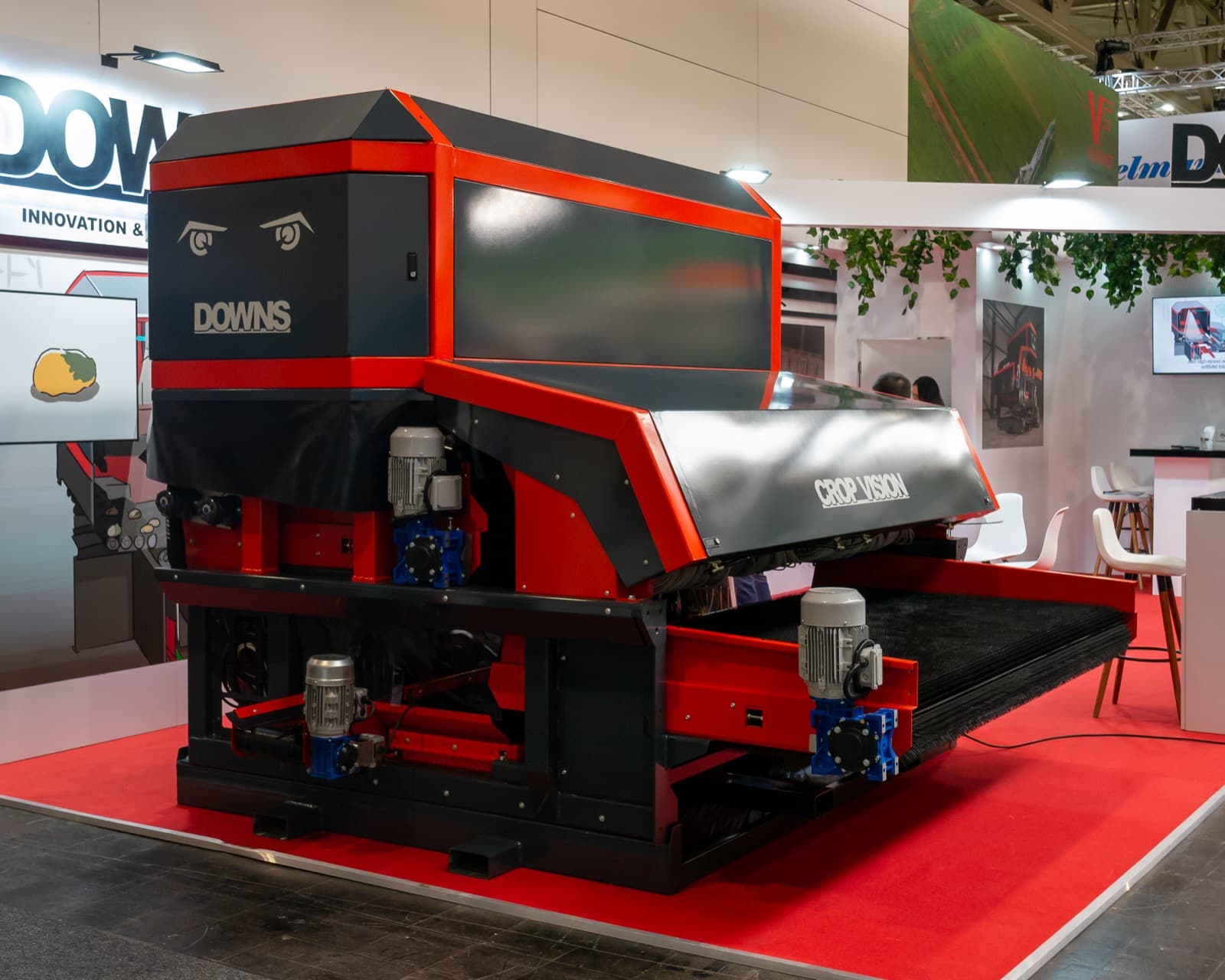
Short answer: an optical sorting machine looks at every piece of food as it passes cameras or other sensors and blows or pushes out the pieces that are defective, the wrong colour, size or shape, or not food at all. Belt sorters suit wet and large product such as potatoes, fries and vegetables; chute or freefall sorters suit dry product such as grains, nuts and seeds; lane graders sort whole produce piece by piece into several grades.
Optical sorters replace the hand pickers who used to stand along an inspection belt. They work in potato and vegetable plants, nut and dried fruit plants, rice and grain mills, seed plants and fresh produce packhouses. This guide explains how they work, the main types, what each crop needs (with potatoes as the worked example), what moves the price, when a used machine makes sense, how to choose, and which makers build them. Every machine figure below is the maker's own, read in October 2026.
How does an optical sorting machine work?
Every optical sorter does four things, in this order:
- Spread the product. A vibrating feeder, a fast belt, rollers or a chute spread product into a single even layer, so no piece hides another.
- Look at every piece. Sensors view each piece as it passes, often from above and below, or from several sides as it turns.
- Decide. Software compares what the sensors see with the reject rules set for that product and grade, in a fraction of a second.
- Reject. A bank of fast air valves fires a short puff at each rejected piece, or a mechanical finger knocks it into a separate outlet. Good product carries on.
The number of ejectors sets how finely a sorter can aim. Bühler, for example, lists 384 individual ejectors on its SORTEX F PolarVision, and Raytec's Ingenuity uses 60 to 200 mechanical fingers depending on the model.
The sensors decide what a sorter can see
| Sensor | What it sees | Typical targets |
|---|---|---|
| Colour camera (RGB) | Colour, spots, visible shape | Green skin, dark rot, burnt pieces, discoloured kernels, wrong colour |
| Laser | How light scatters inside and on the surface | Stones, glass, plastic, wood and shell, even when they are the same colour as the product |
| Near-infrared or hyperspectral camera | Differences in chemistry (sugar, moisture, fat) the eye cannot see | Foreign organic material such as wood, shell and plastic of the same colour, and defects that differ in chemistry rather than colour |
| X-ray | Density | Stones, glass and metal hidden in or under product, some internal defects |
| Shape or 3D camera | Length, width, volume and shape | Size grading, misshapes, broken pieces |
| Light transmission | Light passing through the piece | Some internal defects in potatoes and onions |
Many sorters combine two or more sensors. Ask which sensor finds each defect on your list.
Where AI fits
Many makers now add machine learning or deep learning trained on images of the customer's own product. It helps the sorter tell a real defect from natural colour variation in the skin, and recognise defects that do not follow a simple colour rule. Agrograde, for example, says its Vector sorter maps the exact defect region on each potato rather than sorting on colour alone. AI cannot find what the sensors cannot see, so the sensor choice comes first and the software second.
Types of optical sorter
| Type | How product passes the sensors | Best for | Examples (maker's own figures) |
|---|---|---|---|
| Belt sorter | Carried flat on a fast belt and viewed as it flies off the end, often from above and below | Wet, large, sticky or fragile pieces: raw and peeled potatoes, fries, chips, vegetables, fruit | TOMRA 5B (one or two reject streams); Key Technology COMPASS B60 and B120 (600 and 1200 mm inspection width); Satake BELTUZA (650 mm belt) |
| Chute or freefall sorter | Slides down a channel or falls through the air in a thin curtain past the cameras | Dry, free-flowing product: rice, grains, seeds, beans, nuts, dried fruit, frozen vegetables | Bühler SORTEX A (up to 40 t/h); Bühler SORTEX F PolarVision (up to 20 t/h, 384 ejectors); TOMRA 5C and Blizzard; ANYSORT SC PRO rice sorters |
| Roller or spin-belt sorter | Rollers turn each piece as it passes, so the cameras see it from several sides | Whole potatoes, onions, carrots, citrus, apples | Raytec Spiryt SY-1200 (18-20 t/h on 60 mm potatoes, six cameras); Raytec Opportunity (up to 10, 20 or 30 t/h); Agrograde Vector (up to 8 images per item) |
| Lane or cup grader | Each piece rides in its own lane or cup, is photographed many times and dropped into one of several outlets | Grading whole produce by quality, size and shape into many classes | Newtec Celox-P-DUAL-UHD (4, 8 or 12 lanes, up to 16 outlets); Ellips Elisam (2 to 5 t/h per lane, 90 images per potato) |
| Farm or intake sorter | Unwashed product on a wide belt, with fingers knocking out stones and clods | Potatoes and root crops at harvest and out of storage | TOMRA 3A (up to 100 t/h); TOMRA Sentinel II (20-200 t/h across the range); Ellips CleanFlow pre-sorter |
Figures as each maker publishes them, read on its own site in October 2026. Capacity depends on the product, piece size and defect level.
A 2-way sorter splits accept from reject. A 3-way sorter adds a third stream, often for product that can be reworked or sold as a lower grade: Raytec builds its Ingenuity in both versions, and TOMRA's 5B removes defects in one or two reject streams.
What each crop needs
Potatoes: the worked example
Potatoes pass optical sorters at more points than almost any other food, and each point needs a different machine. For the full potato buyer's guide, including roller graders, see potato grading and sorting machines on IndianPotato; for how growers and packhouses in India sort and grade, see potato sorting and grading on IndianAgri.
- At harvest and out of storage (unwashed). The job is to take out stones, clods and badly damaged or green tubers before they reach storage or the washer. Machines here are wide and fast, and usually use near-infrared sensors with mechanical fingers, which handle heavy, dirty product better than air. TOMRA gives up to 100 tonnes an hour for its 3A, and 20-200 tonnes an hour across its Sentinel II range; Ellips's CleanFlow pre-sorter handles up to 120 tonnes an hour.
- Grading whole potatoes for the fresh market. Here the potato is graded by size, shape and skin defects into many classes. Lane and cup graders photograph each tuber from all sides. Newtec's Celox-P-DUAL-UHD runs up to 210,000 potatoes an hour on 12 lanes, or up to 30 tonnes an hour depending on potato size, into up to 16 outlets. Ellips's Elisam takes 90 images of every potato as it rotates and gives 2 to 5 tonnes an hour per lane, up to 40 tonnes an hour on 8 lanes. Raytec's Spiryt SY-1200 uses six cameras on a roller belt and gives 18-20 tonnes an hour on 60 mm potatoes.
- Washed and peeled potatoes before cutting. The sorter removes rot, greening, peel left on and bruises before slicing, because every defect that reaches the slicer becomes several defective strips or chips.
- Fries and chips after cutting or frying. On strips, the targets are dark ends ("sugar ends"), bruises, slivers and nubbins; on fried chips, burnt and dark pieces and foreign material. TOMRA's 5B uses lasers and surround-view cameras for 360° inspection of fries and chips. Key Technology's ADR X cuts defects out of potato strips rather than throwing the whole strip away, at up to 15 tonnes an hour, and Bühler lists its SORTEX F PolarVision for frozen fries at up to 20 tonnes an hour.
The defects that matter most on potatoes are greening (colour cameras), rot and soft rot (colour plus near-infrared), stones and clods (near-infrared or laser), wireworm holes, scab and growth cracks (high-resolution cameras that see the whole surface) and internal defects (light transmission or X-ray). Raytec's Spiryt brochure lists wireworms, scab, damage, misshapes, growth cracks, greening, foreign objects, Rhizoctonia and ageing as defects it targets. Agrograde lists rot, sprouts, greening, holes, deep cuts and minor cuts for its Vector sorter, on unwashed, mixed lots.
Questions to ask on a potato trial: how much good potato goes out with the rejects; how many green or rotten tubers are left in the accept stream; whether it copes with dirty, wet and mixed-variety lots; how it handles the smallest and largest tubers you grade; and how long cleaning takes at the end of a shift.
Fries and frozen vegetables
Frozen product is usually sorted on a chute or freefall machine after the freezer, where pieces are free-flowing. TOMRA's Blizzard and 5C and Bühler's SORTEX F PolarVision are built for this. Check how the sorter copes with ice, frost on the lenses and condensation when the line warms up.
Nuts and dried fruit
Nuts need shell, stones and rotten or discoloured kernels removed. Chute sorters with colour, near-infrared and sometimes laser or X-ray dominate. Bühler's SORTEX F BioVision gives up to 12 tonnes an hour and detects defects as small as 2 mm.
Rice, grains, seeds and beans
Small, dry, uniform pieces suit chute sorters with many narrow channels. Bühler's SORTEX A gives up to 40 tonnes an hour and can sort into up to five chutes. ANYSORT's SC PRO rice sorters run from 2-7 tonnes an hour (SC2 PRO) to 13-42 tonnes an hour (SC12 PRO). Satake's compact PIKASEN FMS2000-F has a single 240 mm chute and two full-colour cameras.
Fruit and vegetables
Whole fruit and root vegetables are sorted on roller or spin belts that turn each piece: Raytec's Opportunity gives up to 10, 20 or 30 tonnes an hour by width. Cut and leafy vegetables go on belt sorters, where foreign material (stalks, stones, insects, plastic) matters as much as defects.
How much does an optical sorter cost?
None of the ten makers we read publishes a price on its own site: TOMRA, Key Technology, Bühler, Satake, Newtec, Ellips, Raytec Vision, ANYSORT, Angelon and Agrograde all quote per line. We do not estimate prices. These are the things that move a quote, so ask every maker to price the same specification:
- Width and capacity. A wider machine with more channels or lanes handles more tonnes an hour and costs more.
- Sensors. A colour-only sorter costs less than one with lasers, near-infrared, hyperspectral or X-ray, and two-sided viewing costs more than one side.
- Ejectors and outputs. The number of ejectors, air jets or fingers, and 2-way or 3-way rejection.
- Hygiene and build. Washdown design, stainless steel grade, IP rating and dust-proofing for dry products.
- Software and AI. Product libraries, AI training on your product, remote support and software updates.
- Line work. Feeding and spreading conveyors, reject handling, installation, training and spare parts.
- Running cost. Compressed air on air-jet sorters, power, cleaning time, and the good product lost with the rejects.
Used and refurbished optical sorters
A used sorter can make sense for a simple, proven job such as removing stones from raw potatoes or discoloured kernels from beans. Before buying:
- check the machine's year, software version and whether the maker still supplies parts and updates;
- check cameras, lights, lenses and valves, which wear and drift;
- ask for a trial run on your own product, with the reject stream measured;
- ask whether the maker or a local engineer will service it;
- budget for re-training the reject rules on your product.
A machine that cannot be updated or serviced costs more in lost product than it saves on price.
How to choose an optical sorter
- List the defects that cost you money, in order: foreign material, rot, greening, sugar ends, discoloured kernels, wrong size. Ask each maker which sensor sees each one.
- Fix the job: tonnes per hour (normal and peak), piece size range, wet or dry, raw or cut, and where in the line the sorter sits.
- Choose the type: belt, chute or freefall, roller, or lane grader (see the types table).
- Test with your own product, with real defects, ideally from a bad part of the season. Ask for two numbers: good product lost in the reject stream, and defects left in the accept stream.
- Count running costs: air, power, cleaning time, wear parts and yield loss.
- Check service: how fast an engineer can come, spare parts stock, remote support and training for your operators.
Optical sorter makers
| Maker | Where | Optical sorters on its own site | Main foods |
|---|---|---|---|
| Agrograde (Occipital Technologies) | Pune | Vector Series AI optical sorter, 1–20 t/h across variants | Potato, onion, tomato |
| ANYSORT (Anhui Jiexun Optoelectronic) | Hefei, China | MK belt series (0.5-10 t/h), SC PRO rice series (2-42 t/h), tea sorters | Rice, grains, nuts, beans, frozen produce, french fries, tea |
| Angelon | Hefei, China | Belt and chute colour sorters, chilli sorters with 256 to 768 nozzles | Chillies, nuts, beans, garlic, coffee, seafood |
| Bühler (SORTEX brand) | Uzwil, Switzerland; SORTEX in London, UK | SORTEX A, F PolarVision, F BioVision and J SpectraVision chute sorters | Grains, pulses, seeds, coffee, nuts, frozen fruit and vegetables, fries |
| Ellips (Elisam) | Eindhoven, Netherlands | Elisam cup graders for potatoes, onions and fruit; CombiGrader; CleanFlow pre-sorter | Potatoes, onions, fruit |
| Key Technology | Walla Walla, USA | COMPASS belt and chute sorters, VERYX, ADR defect removal for strips | Potato products, vegetables, fruit, nuts |
| Newtec | Odense, Denmark | Celox optical lane graders for potatoes and carrots | Potatoes, carrots |
| Raytec Vision | Parma, Italy | Spiryt, Opportunity, Ingenuity, Raynbow, Curiosity and others; X-ray machines | Potatoes, fruit, vegetables, nuts, dried products |
| Satake | Higashi-Hiroshima, Japan | BELTUZA belt sorter, PIKASEN, EZER and EVOLUTION chute sorters | Rice, grains, beans, nuts, seeds, coffee |
| TOMRA Food | Asker, Norway | TOMRA 3A, 5A, 5B, 5C, 5X, Blizzard, Sentinel II and others | Potatoes and potato products, vegetables, fruit, nuts, dried fruit |
Alphabetical. Read on each maker's own site in October 2026. Inclusion is not a ranking or a recommendation.