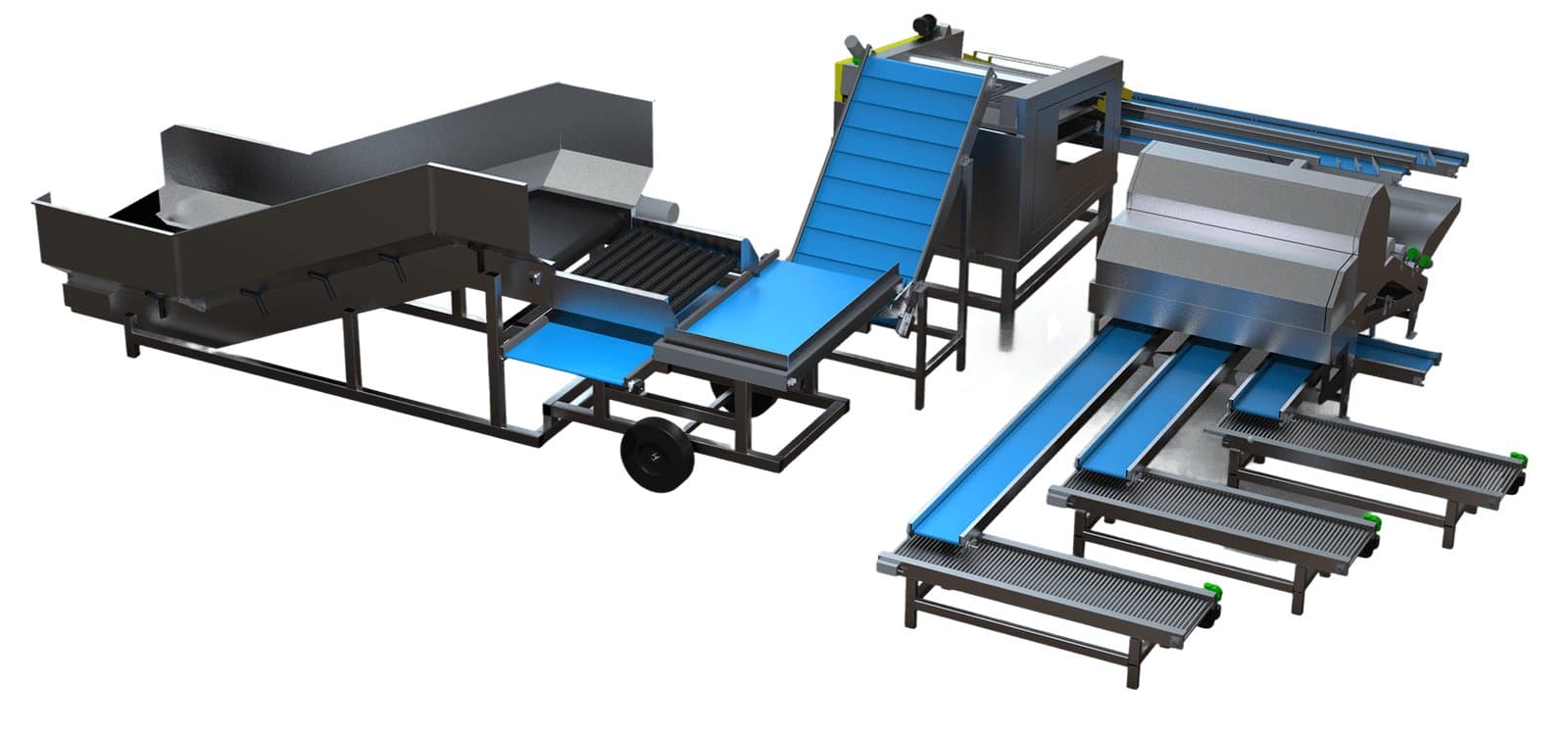
Agrograde (Occipital Technologies) · optical sorter
Vector Series AI
- Capacity
- 1–20 t/h
- Output streams
- 2–4
- Product size
- 20–160 mm
Food Safety & Inspection · 32 models from 10 makers
An optical sorter is a machine that looks at every piece of product as it passes, decides in a fraction of a second whether it is good or bad, and removes the bad pieces, usually with a short blast of compressed air or a mechanical finger.
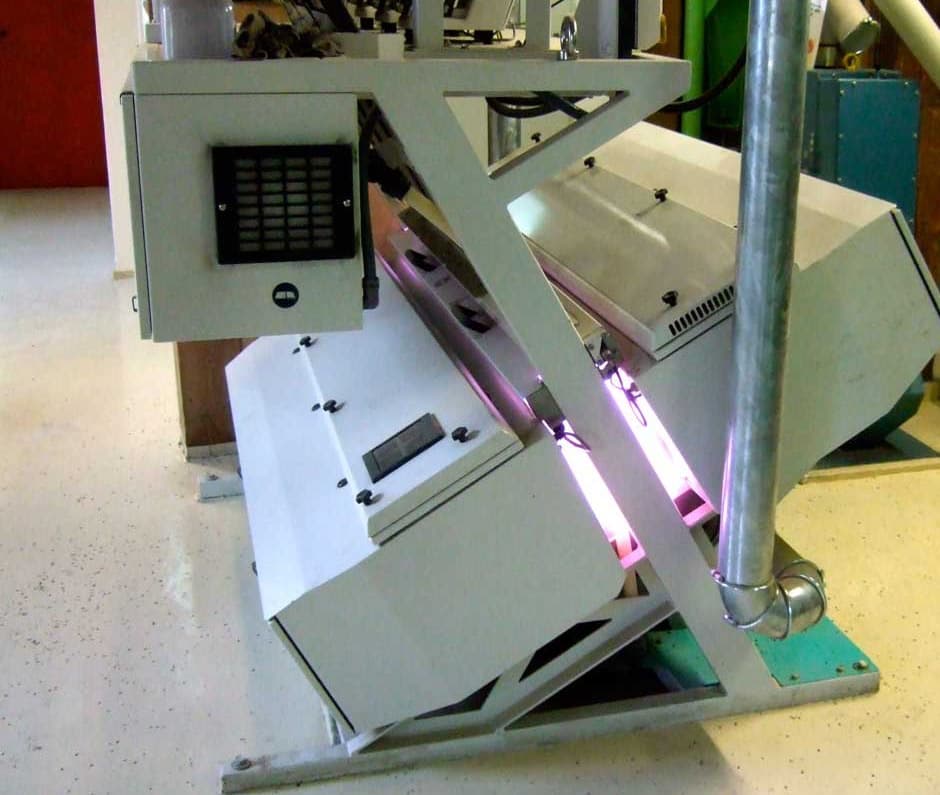
Photo: BMK · Wikimedia Commons · CC BY-SA 3.0
An optical sorter is a machine that looks at every piece of product as it passes, decides in a fraction of a second whether it is good or bad, and removes the bad pieces, usually with a short blast of compressed air or a mechanical finger.
Optical sorters sit wherever a line needs to take out what people used to pick by hand: rotten, green, bruised or discoloured pieces, foreign material such as stones, glass, plastic, wood and insects, and product with the wrong colour, size or shape. On a potato line they work on raw tubers before peeling, on peeled potatoes and on cut strips before the fryer. In nut, grain and seed plants they take out discoloured kernels, shells and stones. In frozen vegetable and fruit plants they remove stalks, leaves, foreign bodies and defects before freezing or packing.
There are two main designs. Belt sorters carry product flat on a fast conveyor and view it as it flies off the end, which suits wet, sticky, large or fragile pieces such as potatoes, fries, vegetables and fruit. Chute or freefall sorters let product slide down a channel or fall through the air in a thin curtain past the cameras, which suits dry, free-flowing product such as rice, grains, seeds, beans, nuts and dried fruit. Lane sorters and camera graders hold each piece in its own lane or cup, turn it and photograph it from several sides, then grade it by size, shape and defects into several outlets, which suits whole potatoes, onions, fruit and other produce sold by grade.
The sensors decide what a sorter can see. Colour cameras see colour and visible spots. Lasers see structure and can tell foreign material from product of the same colour. Near-infrared and hyperspectral cameras see differences in chemistry, such as sugar or moisture, that the eye cannot. X-ray finds dense foreign bodies and some internal defects. Many sorters now add shape analysis and machine learning trained on images of the customer's own product.
Cost depends on the width of the machine and its capacity, the number and kind of sensors, the number of ejectors and output streams, the hygienic design, and the software. Running cost depends mostly on compressed air, cleaning time, and the good product lost with the bad.
Where it sits in the line
An optical sorter looks at food as it moves past cameras or lasers and picks out the pieces that are bad, the wrong colour or not food at all. A computer decides in a split second, and a puff of air or a small finger pushes the bad piece out of the stream. It does the job of a row of people picking by hand, without getting tired.
A shaker or belt spreads product into a thin, even layer so no piece hides another.
Cameras, lasers or other sensors view each piece from one or more sides as it passes.
Software compares each piece with the reject rules set for that product and grade.
Air jets or fingers push rejected pieces into a separate stream; good product carries on.
Every figure comes from the maker's own document.
Agrograde (Occipital Technologies) · optical sorter
ANYSORT (Anhui Jiexun Optoelectronic Technology)
2.0–10 t/h
Capacity
ANYSORT (Anhui Jiexun Optoelectronic Technology) · optical sorter
ANYSORT (Anhui Jiexun Optoelectronic Technology)
0.5–2.0 t/h
Capacity
ANYSORT (Anhui Jiexun Optoelectronic Technology) · optical sorter
ANYSORT (Anhui Jiexun Optoelectronic Technology)
13–42 t/h
Capacity
ANYSORT (Anhui Jiexun Optoelectronic Technology) · optical sorter
ANYSORT (Anhui Jiexun Optoelectronic Technology)
2–7 t/h
Capacity
ANYSORT (Anhui Jiexun Optoelectronic Technology) · optical sorter
Bühler Group
40 t/h
Capacity
Bühler Group · optical sorter
Bühler Group
12 t/h
Capacity
Bühler Group · optical sorter
Bühler Group
20 t/h
Capacity
Bühler Group · optical sorter
Bühler Group
1–7
Channels or chutes
Bühler Group · optical sorter
Ellips B.V. (Elisam)
15 t/h
Capacity
Ellips B.V. (Elisam)
2–40 t/h
Capacity
Hefei Angelon Electronics
256
Ejectors
Hefei Angelon Electronics · optical sorter
Hefei Angelon Electronics
512
Ejectors
Hefei Angelon Electronics · optical sorter
Hefei Angelon Electronics
768
Ejectors
Hefei Angelon Electronics · optical sorter
Key Technology
1200 mm
Sorting width
Key Technology · optical sorter
Key Technology
600 mm
Sorting width
Key Technology · optical sorter
Key Technology
1200 mm
Sorting width
Key Technology · optical sorter
Key Technology
600 mm
Sorting width
Key Technology · optical sorter
Newtec A/S
4–12
Channels or chutes
Newtec A/S
30 t/h
Capacity
Newtec A/S · optical sorter
Raytec Vision S.p.A.
50–70 m/min
Belt speed
Raytec Vision S.p.A. · optical sorter
Raytec Vision S.p.A.
10–30 t/h
Capacity
Raytec Vision S.p.A. · optical sorter
Raytec Vision S.p.A.
50–72 m/min
Belt speed
Raytec Vision S.p.A. · optical sorter
Raytec Vision S.p.A.
18–20 t/h
Capacity
Satake
11.3 t/h
Capacity
Satake
1814 kg/h
Capacity
TOMRA Food
100 t/h
Capacity
TOMRA Food
1.0–2.0 kVA
Power
TOMRA Food
2–3
Output streams
TOMRA Food
10.5 kVA
Power
TOMRA Food
3 kVA
Power
TOMRA Food
20–200 t/h
Capacity
Featured Partner slot · open
Be the maker buyers see first on this page
| Model | Maker · country | Capacity | Capacity | Sorting width |
|---|---|---|---|---|
| Vector Series AIPDF | Agrograde (Occipital Technologies) · IN | 1–20 t/h | — | — |
| MK384PDF | ANYSORT (Anhui Jiexun Optoelectronic Technology) · CN | 2.0–10 t/h | — | — |
| MK64PDF | ANYSORT (Anhui Jiexun Optoelectronic Technology) · CN | 0.5–2.0 t/h | — | — |
| SC12 PROPDF | ANYSORT (Anhui Jiexun Optoelectronic Technology) · CN | 13–42 t/h | — | — |
| SC2 PROPDF | ANYSORT (Anhui Jiexun Optoelectronic Technology) · CN | 2–7 t/h | — | — |
| SORTEX A (A1 to A5)PDF | Bühler Group · CH | 40 t/h | — | — |
| SORTEX F BioVision (FB1, FB2)PDF | Bühler Group · CH | 12 t/h | — | 600–1200 mm |
| SORTEX F PolarVision (FA1, FA2)PDF | Bühler Group · CH | 20 t/h | — | 600–1200 mm |
| SORTEX J SpectraVision (J1 to J7)PDF | Bühler Group · CH | — | — | — |
| Elisam CombiGrader | Ellips B.V. (Elisam) · NL | 15 t/h | — | — |
| Elisam potato grading machine | Ellips B.V. (Elisam) · NL | 2–40 t/h | — | — |
| A422C16D-256SV6PDF | Hefei Angelon Electronics Co., Ltd. · CN | — | — | — |
| T422C16D-512SV6PDF | Hefei Angelon Electronics Co., Ltd. · CN | — | — | — |
| T622C24D-768SV6PDF | Hefei Angelon Electronics Co., Ltd. · CN | — | — | — |
| COMPASS B120PDF | Key Technology · US | — | — | 1200 mm |
| COMPASS B60PDF | Key Technology · US | — | — | 600 mm |
| COMPASS C120PDF | Key Technology · US | — | — | 1200 mm |
| COMPASS C60PDF | Key Technology · US | — | — | 600 mm |
| Celox-C-UHD-IRPDF | Newtec A/S · DK | — | — | — |
| Celox-P-DUAL-UHDPDF | Newtec A/S · DK | 30 t/h | — | — |
| Ingenuity (IY-2060, IY-2100)PDF | Raytec Vision S.p.A. · IT | — | — | 1500–2500 mm |
| Opportunity (OY-600 to OY-1800)PDF | Raytec Vision S.p.A. · IT | 10–30 t/h | — | — |
| Raynbow (R-230 to R-270)PDF | Raytec Vision S.p.A. · IT | — | — | 750–1750 mm |
| Spiryt SY-1200PDF | Raytec Vision S.p.A. · IT | 18–20 t/h | — | — |
| BELTUZA (CSV600BM)PDF | Satake Corporation · JP | 11.3 t/h | — | — |
| PIKASEN FMS2000-FPDF | Satake Corporation · JP | — | 1814 kg/h | 240 mm |
| TOMRA 3APDF | TOMRA Food · NO | 100 t/h | — | — |
| TOMRA 5APDF | TOMRA Food · NO | — | — | — |
| TOMRA 5BPDF | TOMRA Food · NO | — | — | — |
| TOMRA 5CPDF | TOMRA Food · NO | — | — | — |
| TOMRA BlizzardPDF | TOMRA Food · NO | — | — | — |
| TOMRA Sentinel IIPDF | TOMRA Food · NO | 20–200 t/h | — | — |
Makers of optical sorters: Agrograde (Occipital Technologies) · ANYSORT (Anhui Jiexun Optoelectronic Technology) · Bühler Group · Hefei Angelon Electronics Co., Ltd. · Key Technology · Newtec A/S · Raytec Vision S.p.A. · Satake Corporation · TOMRA Food
Buying criteria
Start from the defects that cost you money. List what must come out (foreign material, rot, green, sugar ends, discoloured kernels, wrong size) and ask each maker which sensor sees each one. A colour camera alone cannot see everything.
Test with your own product. Send a sample with real defects, ideally from a bad part of the season, and ask for the result as good product in the reject stream and defects left in the accept stream, both measured.
Match capacity and width to the line. Ask for the capacity on your product at your defect level, not the maximum in the brochure, and check how the sorter copes with surges.
Count the running cost: compressed air, power, cleaning time, wear parts and the yield lost with the rejects. A machine that throws out less good product can pay for itself on yield alone.
Check hygiene and access for wet or allergen lines, the software and remote support, how fast local service engineers can come, spare parts, and training for the people who will set the reject rules.
Read the full buying guide →Photo: Policarpo Brito / Pexels · Stock
An optical sorter looks at food as it moves past cameras or lasers and picks out the pieces that are bad, the wrong colour or not food at all. A computer decides in a split second, and a puff of air or a small finger pushes the bad piece out of the stream. It does the job of a row of people picking by hand, without getting tired.
It removes pieces that do not match what the operator has set as good product: foreign material such as stones, glass, plastic and wood, and product defects such as rot, greening, bruises, discolouration, shell, stalks, and the wrong size or shape. What it can see depends on its sensors.
A belt sorter carries product flat on a fast conveyor and views it as it leaves the end of the belt, which suits wet, large or fragile food such as potatoes, fries and vegetables. A chute or freefall sorter lets dry, free-flowing product such as grains, seeds and nuts slide or fall past the cameras in a thin curtain.
Many do. Makers increasingly add machine learning or deep learning trained on images of the customer's own product, so the sorter can tell subtle defects from good product. It still needs the right sensors and lighting: software cannot find a defect the camera cannot see.
Few makers publish a price; most quote per line. The price moves with the width and capacity, the sensors (colour only, or laser, near-infrared, hyperspectral or X-ray), the number of ejectors and output streams, hygienic design and software. Compare quotes on the same product, capacity and defect list, and include air and service costs.
Email us your product, tonnes per hour and the defects that must come out. We reply with a shortlist of suitable machines and the questions to ask each maker. We are independent and do not sell machines.
Email us →