Buying guide
Honey processing machines: from the hive frame to the bottle (and to powder)
By Editorial team · Updated
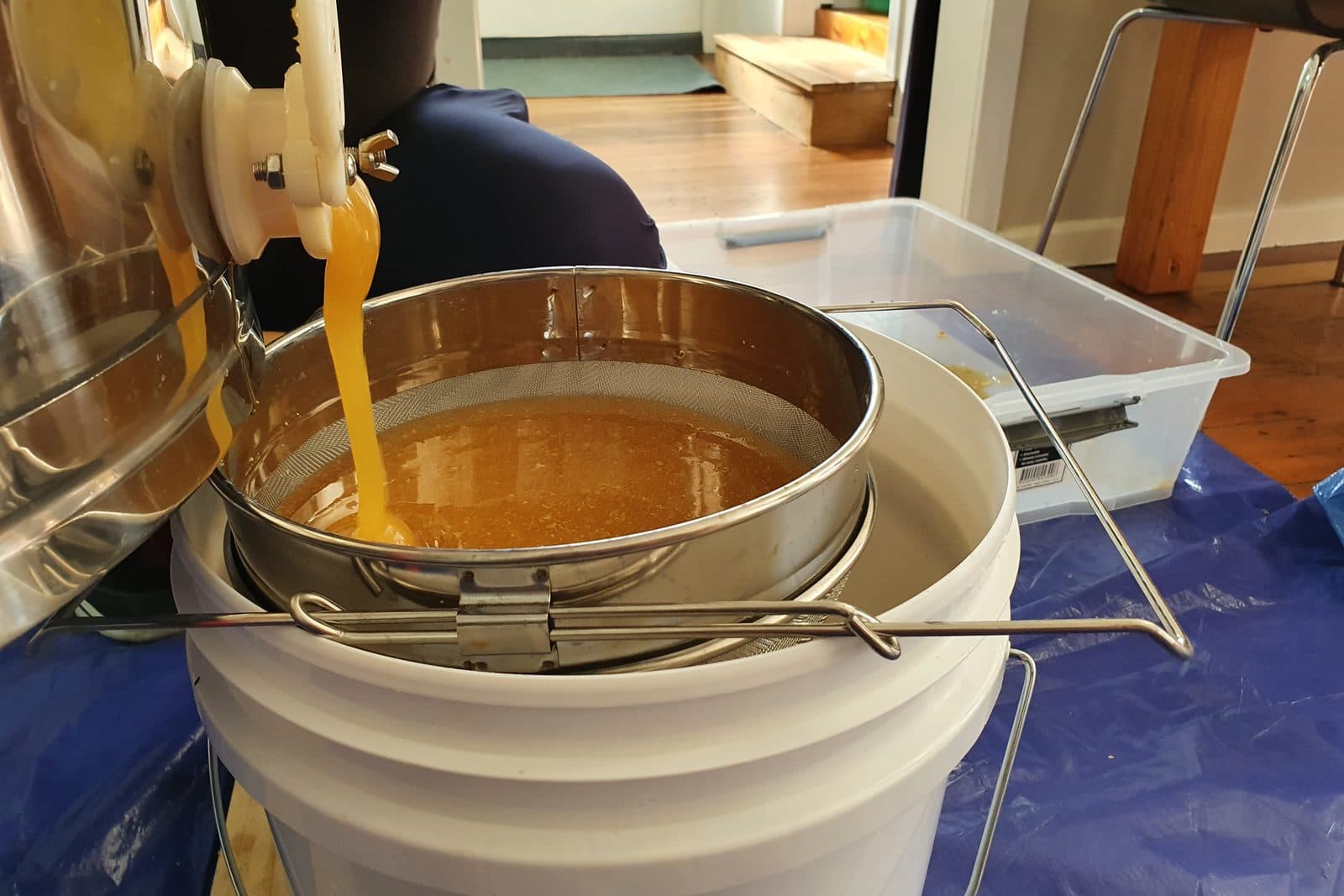
Short answer: honey goes from the hive frame to the bottle in six steps, and each step has its own machine.
- Uncapping: a knife or fork takes the wax caps off the comb.
- Extraction: a centrifugal honey extractor spins the frames so the honey flies out.
- Straining and settling: sieves and a settling tank take out wax and air.
- Warming and moisture reduction: a honey processing plant warms the honey gently and, if it is too wet, brings the moisture down.
- Filtration: a filter removes fine wax and particles.
- Filling: a filling machine puts the honey in jars, bottles, pouches or drums.
Honey powder needs a separate drying line on top of this. The National Institute of Food Technology Entrepreneurship and Management (NIFTEM) sets out the same order in its honey reading manual for the PMFME scheme, which this guide follows step by step. We then cover the machines, plant sizes, government support, licences and the makers whose own sites show these machines.
How is honey processed, step by step?
1. Uncapping. Bees seal ripe honey with wax. NIFTEM says frames that are at least two-thirds capped are uncapped with a long-handled uncapping fork, scraping the caps onto a capping tray. Makers also sell steam-heated and electric-heated uncapping knives.
2. Extraction. The frames go into a honey extractor, a drum that uses centrifugal force. NIFTEM says to start it slowly so the combs do not break. As it spins, honey hits the wall, runs down to the cone-shaped bottom and leaves through a gate. Radial extractors hold frames like the spokes of a wheel; tangential ones hold them flat against the drum. Both come manual or motorised.
3. Straining. Under the gate sits a bucket with a coarse and a fine sieve, as in the photo above. In bigger plants, straining is combined with preheating up to about 40 °C in a jacketed tank with a stirrer (NIFTEM).
4. Liquefying. Honey crystallises naturally. To make it flow again, NIFTEM recommends indirect heat: a water bath or a double-jacketed vat, keeping the honey at about 40 to 45 °C. It warns against a direct flame or electric plate under the drum.
5. Moisture reduction. This is the step that turns a beekeeper's honey into a stable product. The National Bee Board's NBHM guidelines say Indian honey is sometimes harvested at 22 to 25% moisture and must be brought down to 20% or below, because high moisture leads to fermentation and shortens shelf life. Some importers want 18 to 19%. NIFTEM describes vacuum units that work at about 60 °C and air-and-tray units that work at about 49 °C.
6. Filtration. NIFTEM gives a typical set-up: a pressure filter with an 80 µm polypropylene filter, with honey held at 50 to 55 °C so the wax does not melt. Large processors add a centrifugal clarifier and fine filtration. Do not over-filter: the FSSAI standard sets a minimum pollen count.
7. Pasteurising (optional). Some plants pasteurise to slow fermentation and crystallisation. NIFTEM lists 63 °C for 30 minutes, 65.5 °C for 30 minutes, or 77 °C briefly followed by rapid cooling.
8. Settling, filling and labelling. Honey rests in a settling tank so air bubbles rise, then is filled warm, which keeps air out (NIFTEM). Packs range from sachets and squeeze bottles to glass jars and export drums. See our guides to filling machines and, for sachets and stick packs, form-fill-seal machines.
The machines, one by one
| Machine | Job in the line | Capacity as makers state it | Power and material as makers state it | What to ask |
|---|---|---|---|---|
| Uncapping knife or fork, capping tray | Takes the wax caps off the comb before extraction | — (Tiwana Bee Farm lists plain, steam-heated and electric-heated knives) | — | Heated or cold, tray drainage, how cappings are melted later |
| Honey extractor | Spins frames so honey leaves the comb | 4 and 10 frames, motorised; 2 to 20 frames, manual (Tiwana Bee Farm) | SS 304, 16 gauge, 220 V for the 10-frame radial (Tiwana Bee Farm) | Radial or tangential, frame size it takes, motor and speed control, steel grade |
| Settling tank | Lets air and wax rise before filling | — (Tiwana Bee Farm lists one, no size given) | — | Volume, jacket, outlet height, gate valve |
| Honey processing plant | Warms, removes moisture and filters honey | 100 to 1,000 kg an hour (G.D. Agro Industries); 100 kg a batch, 600 kg a shift (Blacknut) | 5 to 18 kW, SS 304/316 (G.D. Agro Industries); SS304 (Blacknut) | Moisture in and out, vacuum or open, top temperature, time at temperature, filter micron |
| Filtration unit | Removes wax and fine particles | 500 kg a day, 150 litres (Ylem Energy portable filtration plant) | 6 kW, SS304 (Ylem Energy) | Mesh or micron size, how it keeps the pollen the standard needs |
| Filling machine | Fills jars, bottles, pouches or sachets | 50 to 500 g, 6 to 10 cycles a minute (Brothers Pharmamach); up to 48 to 72 bottles a minute on 8 heads (Multipack) | SS 316 hopper and nozzles (Multipack) | Piston or servo, warm filling, drip control, pack sizes |
| Dryer (honey powder only) | Dries honey with a carrier into powder | — (Shanghai Minjie and GEA publish no honey capacities on the pages read) | — | Trial on your recipe, carrier needed, powder moisture, stickiness |
“—” means no maker page we read gives the value. Read on the makers’ own sites on 21 Oct 2026.
Check every part that touches the honey. The makers we read list SS 304 or SS 316 for contact parts.
Beekeeper, cluster unit or factory: what each needs
A beekeeper needs an uncapping knife, a capping tray, an extractor sized to his frames, sieves and food-grade buckets. Manual extractors are enough for a few dozen boxes; motorised ones save labour as numbers grow.
A beekeepers' group, FPO or cluster unit that buys honey from many members needs a processing plant with moisture reduction and filtration, a settling tank, a filler and a basic lab for moisture and HMF at the receiving point. This is the level the government's honey mission funds.
A factory or exporter runs bigger processing plants, often more than one line, a full lab, drum and retail filling, and cold or dry storage. NIFTEM also publishes a model project report for a small honey packaging unit, which lists the machines such a unit needs.
Most makers quote on request. Three of the makers we checked list prices on their own sites:
| Maker and item | As listed | Listed price |
|---|---|---|
| Tiwana Bee Farm: honey extractor, manual | Stainless steel | ₹18,000 a piece |
| Tiwana Bee Farm: 10-frame motorised radial extractor | SS 304, 16 gauge, 220 V | ₹70,000 a unit |
| Tiwana Bee Farm: 4-frame motorised extractor | 24 gauge | ₹40,000 a piece |
| Blacknut: honey processing plant | 100 kg a batch, 600 kg in an 8-hour shift, SS304 | From ₹4,25,000 a unit |
| Blacknut: honey filling machine | Add-on to its plant | ₹50,000 |
| Ylem Energy: processing plant with moisture reduction unit | 50 litres, 100 kg a day, SS304, 5 kW | ₹3,50,000 a unit (approx.) |
| Ylem Energy: 200 kg processing machine with vacuum evaporation | 500 kg a day, SS304, 15 kW | ₹5,00,000 a unit (approx.) |
| Ylem Energy: portable honey filtration plant | 150 litres, 500 kg a day, 6 kW | ₹1,12,000 a unit (approx.) |
Prices as shown on each maker’s own site on 21 Oct 2026. None of the pages says whether GST, freight or installation are included. Not an offer from us, and not a market average.
Making honey powder: the extra line
Honey powder is not made on honey machines. It needs a drying line after the honey plant:
- Mixing tank: honey is diluted and mixed with a drying carrier such as maltodextrin.
- Dryer: a spray dryer, a vacuum (belt) dryer or a freeze dryer turns the mix into a dry solid. Shanghai Minjie sells a continuous vacuum dryer for honey and offers trials on your material; GEA makes spray dryers for food powders.
- Mill and sieve: the dried honey is ground and sized.
- Moisture-proof packing: powder picks up water from the air, so it goes into sealed laminate bags or sachets.
Honey is hard to dry. Shi, Fang and Bhandari (Drying Technology, 2013) recovered no powder when they spray-dried pure honey; recovery rose above 50% only with a carrier. So ask any dryer maker for a trial on your own honey and carrier. For what honey powder is, how buyers specify it and who makes it, see our sister guide on honey powder.
Government support for a honey unit
The National Beekeeping and Honey Mission (NBHM) is run by the National Bee Board under the Ministry of Agriculture. Its post-harvest arm, Mini Mission II, funds processing units, testing labs, packaging and storage. The October 2020 operational guidelines set these limits:
| NBHM component (Mini Mission II) | Cost the guidelines consider | Maximum assistance |
|---|---|---|
| Honey processing or export unit | Up to ₹500 lakh | Up to ₹300 lakh |
| Renovation or extension of an old processing unit | ₹30 lakh per unit | Up to ₹20 lakh |
| In-house testing lab in a processing unit | ₹100 lakh | Up to ₹50 lakh |
| Packaging, storage, cold storage | ₹80 lakh | Up to ₹60 lakh |
| Collection, branding and marketing centre | ₹30 lakh | Up to ₹20 lakh |
From the NBHM Operational Guidelines, National Bee Board, October 2020 (paras 4.43 to 4.49), read on 21 Oct 2026. Assistance covers up to 100% of eligible machinery cost and up to 30% of building cost (70% for packaging and storage). A detailed project report goes to the National Bee Board.
A PIB backgrounder from November 2025 says 26 honey processing units had been sanctioned under NBHM by March 2025, with a total outlay of ₹500 crore for FY 2020-21 to FY 2025-26. That period has now ended, so check with the National Bee Board whether the scheme and these limits still apply before you prepare a project report. The same backgrounder describes the Madhukranti portal for registering beekeepers and tracing the source of honey.
Licences and rules, in short
- FSSAI registration or licence. Every food business must hold one before it makes or sells food.
- The honey standard. FSSAI regulation 2.8.3 (compendium Version XXV, 23 September 2022) sets moisture at most 20.0%, HMF at most 80 mg/kg, sucrose at most 5.0% for most honeys, and a minimum pollen count of 5,000 per gram, among other limits. Honey sold as such may have nothing added to it, and must not be heated or processed so far that its essential composition changes. The standard applies to packaged and processed honey.
- Testing. Plan for at least moisture and HMF on every lot you receive; the NBHM guidelines treat an in-house lab as part of a processing unit.
- Labels. NIFTEM lists the word "Honey" or the floral source, net weight, packer's name and address, FSSAI number, nutrition table and country of origin.
Who makes honey processing machines?
We list only makers whose own website shows the machine. Inclusion is not a ranking or a recommendation.
| Maker | Where | Honey machines on its own site | Prices on its site |
|---|---|---|---|
| Tiwana Bee Farm | Doraha, Ludhiana, Punjab, India | Manual and motorised extractors, uncapping knives, settling tank, processing plant, bottling machine | Yes, for extractors |
| G.D. Agro Industries | Ambala Cantt, Haryana, India | Honey processing plants GD-HPP-100 to GD-HPP-1000 (dewaxing, pre-heating, vacuum dehydration, filtration, storage) | No, on request |
| Blacknut Agrifood Machinery | Ambala, Haryana, India | Honey processing plant (heating, moisture reduction, filtration), filling add-on | Yes |
| Ylem Energy | New Delhi, India | Processing plants with moisture reduction or vacuum evaporation, filtration plant | Yes, approximate |
| GOMA | India | Honey processing plant: filtration, pasteuriser, dehydration, filling station | No |
| Brothers Pharmamach | Ahmedabad, Gujarat, India | VISCOFILL-20 single-head filler for honey | No |
| Multipack Machinery | Ahmedabad, Gujarat, India | Servo piston honey filler, 2 to 8 heads | Not clearly stated |
| Shanghai Minjie Machinery | Shanghai, China | Vacuum low-temperature continuous dryer for honey (powder) | No |
| GEA | — | Spray dryers for food and dairy powders | No |
Read on each maker’s own site on 21 Oct 2026; the Tiwana Bee Farm and Ylem Energy sites are built by IndiaMART on the makers’ own domains. “—”: the page read does not say. Marketplace listings are left out.
If you make honey extractors, processing plants, fillers or dryers and want to appear here, ask about a Featured Partner listing. Paid listings are always labelled "Featured Partner · paid placement" and never change the order of the list.
What to ask a honey machine maker
Send every maker the same brief: honey per day or per season, its usual moisture, your pack sizes, and whether you want honey powder later. Then ask:
- What moisture can the plant take in, and what will it bring it down to, in how long?
- What is the highest temperature the honey reaches, and for how long?
- Is moisture removed under vacuum or with warm air?
- What filter size is used, and will the honey still meet the FSSAI pollen count?
- Which parts touch the honey, and are they SS 304 or SS 316?
- What does the price include: GST, freight, installation, training, spares?
- Who supplies the boiler or heater, the lab equipment and the filling machine, if not you?
Buying honey rather than making it?
If you are comparing branded honey prices, our sister site has a dated table of honey prices in India, read brand by brand.